Xiamen Tmax Battery Equipments Limited was set up as a manufacturer in 1995, dealing with lithium battery equipments, technology, etc. We have total manufacturing facilities of around 200000 square foot and more than 230 staff. Owning a group of experie-nced engineers and staffs, we can bring you not only reliable products and technology, but also excellent services and real value you will expect and enjoy.
Sodium Battery Pilot Equipment: Overview, Features, Manufacturing Process, Applications, Advantages, and Conclusion
Sodium battery pilot equipment refers to specialized machinery designed for the research, development, and small-scale production of sodium-ion batteries. Sodium-ion batteries are gaining attention as a cost-effective and environmentally friendly alternative to lithium-ion technology due to the abundance and low cost of sodium. Pilot equipment provides a controlled and precise environment for testing materials, optimizing assembly processes, and producing small batches of batteries for performance evaluation, making it an essential tool in both research laboratories and pilot production facilities.
Overview
Sodium battery pilot equipment is engineered to handle sensitive electrode materials, separators, and electrolytes with high accuracy under controlled conditions. It supports multiple cell formats, including pouch, cylindrical, and prismatic cells, and integrates automation to minimize human error, ensure reproducibility, and improve efficiency. With precise control over electrode stacking or winding, electrolyte filling, and sealing, pilot equipment enables reliable small-scale battery production for R&D and pilot manufacturing purposes, bridging the gap between laboratory experiments and industrial-scale manufacturing.
Key Features of Sodium Battery Pilot Equipment
Key features of sodium battery pilot equipment include:
Precision Electrode Handling: Accurate alignment and stacking or rolling of anode, cathode, and separator layers for consistent cell performance.
Controlled Electrolyte Filling: Ensures uniform wetting of electrodes to optimize ionic conductivity and battery efficiency.
Vacuum or Inert Atmosphere Capability: Protects sodium materials from moisture and oxygen contamination.
Reliable Sealing Mechanisms: Heat or ultrasonic sealing provides airtight and mechanically stable battery cells.
Automation and Programmability: Adjustable parameters allow testing of different battery formats, materials, and sizes.
Integrated Monitoring Systems: Real-time inspection of electrode alignment, electrolyte distribution, and sealing integrity ensures consistent output and reduces defects.
Manufacturing Process
The sodium battery fabrication process using pilot equipment typically includes:
Electrode Preparation: Cutting, coating, and drying sodium-ion anodes and cathodes with precise specifications.
Stacking or Winding: Carefully arranging electrodes and separators into stacked or rolled configurations inside the battery casing.
Electrolyte Injection: Controlled filling ensures complete electrode wetting and optimal ion transport.
Sealing: Heat or ultrasonic sealing encapsulates the battery, providing airtight and mechanically stable protection.
Formation and Testing: Initial charge-discharge cycles stabilize the battery, by evaluation of key parameters such as voltage, capacity, and internal resistance.
Pilot equipment allows flexible parameter adjustments to support R&D experiments, prototype production, and pre-industrial testing.
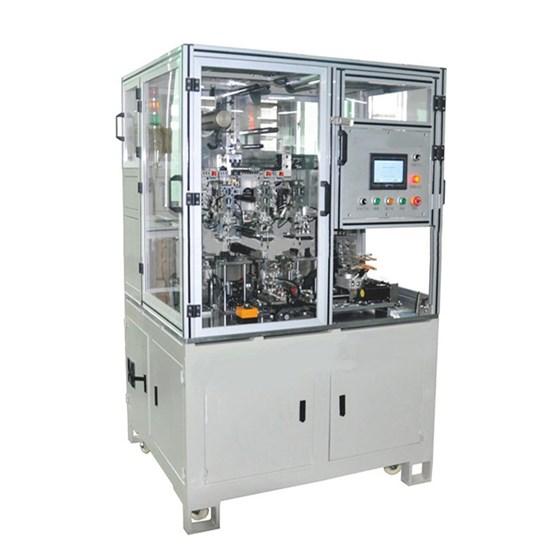
Layer Stacking Machine
Applications
Sodium battery pilot equipment is widely used in:
Research and Development: Testing new electrode materials, electrolytes, and cell designs.
Prototype Production: Producing small batches of sodium-ion batteries for performance evaluation.
Material Optimization: Studying the effects of different coatings, separators, and electrolyte compositions.
Educational and Training Purposes: Teaching battery assembly and testing techniques to researchers and engineers.
Pre-Industrial Testing: Generating data to inform process improvements before scaling up to full production.
Advantages
The main advantages of sodium battery pilot equipment include:
High Precision and Reproducibility: Ensures consistent assembly and reliable experimental results.
Controlled Environment: Vacuum or inert atmosphere minimizes contamination risks.
Flexibility: Supports multiple cell formats, chemistries, and experimental conditions.
Cost-Effective Development: Enables small-batch production without committing to full-scale manufacturing.
Enhanced Safety: Airtight sealing and controlled processing reduce the risk of leaks or short circuits.
Scalable Insights: Data collected at the pilot stage guides industrial-scale production for efficiency and quality.
Conclusion
In conclusion, sodium battery pilot equipment is a vital tool for advancing sodium-ion battery technology. By combining precise electrode handling, controlled electrolyte filling, vacuum or inert gas processing, and reliable sealing, this equipment enables the production of high-quality, reproducible battery prototypes. It is indispensable for research, development, prototype production, and pre-industrial testing, providing the insights necessary to optimize materials and assembly processes before large-scale industrial manufacturing. With its precision, flexibility, safety, and scalability, sodium battery pilot equipment plays a crucial role in developing sustainable, cost-effective, and next-generation energy storage solutions.




 rede ipv6 suportada
 pt
pt en
en fr
fr de
de ru
ru es
es ko
ko tr
tr pl
pl th
th


